Showing posts with label Blue Cheese. Show all posts

Tuesday, October 19, 2010

Trying Cheese


It has been a while ago since I bought my cheese trier. Since then I used it once. I have never dared to cut a core out of a cheese, afraid I would damage or contaminate it. But today I decided to give it a try. I have quite a few cheeses aging and I am curious how they are. I figure it will be a good learning curve to taste a cheese at different stages of development.
The first cheese I cored was a washed curd tomme made on July 6. The number imprinted in the rind refers to the batch number. At 3 months, this cheese was well developed and had a good body. The paste was smooth, perhaps a little granular. Being a washed curd cheese, it occurred to me that it had a typical Gouda undercurrent. I will let it age some more, I am sure it will improve with age.
The second wheel I tried was the last batch of blue I made. This was September 7, a sunny day in NYC according to my records. This cheese was made with Ayrshire milk, the breed of choice for my blue cheeses. I used my own homemade Penicillium rocqueforti, which I wrote about here. Initially I was afraid it wasn't working, it took a while for the blue to show up. But the core clearly shows blueing. At six weeks, this cheese is very mild and is definitively in need of some more aging time.
The last cheese I used the cheese trier on was an 8 months alpine style. Made on February 13 from Jersey milk, this cheese is almost ready to be cut into. The paste smells buttery, it has a sweet taste and it melts on the tongue. Being a cheese made from winter milk, the paste is a little pale.


Tuesday, August 31, 2010

Cave Content


I have been upstate for a month or so working among other things on the creamery. I will post an update about the creamery within the next few weeks. As I don't have easy access to internet upstate, I haven't posted much lately, my excuses for my absence.
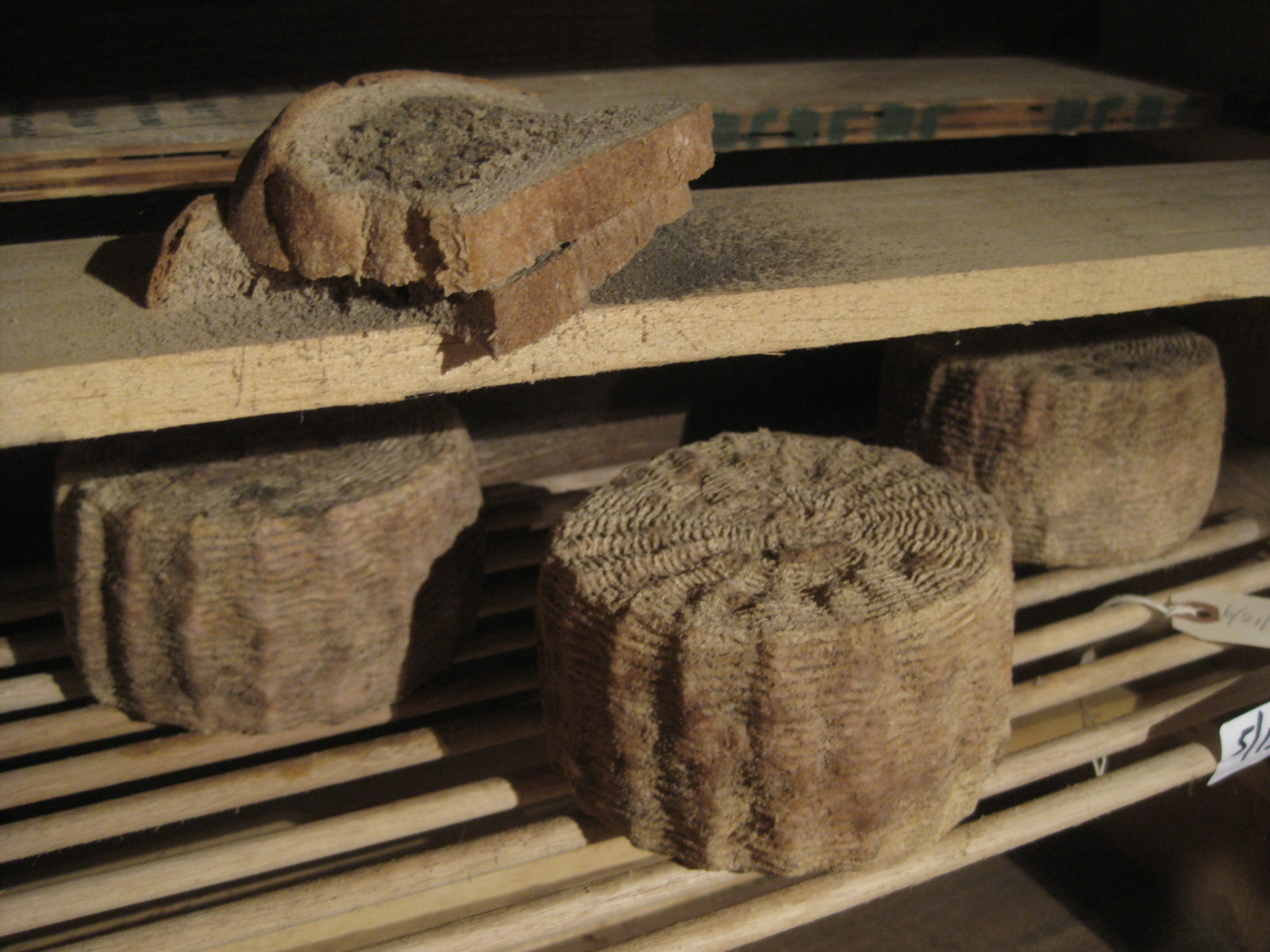
I had taken all the cheeses with me and put them in the basement under the house. It stays relatively cool in there and the humidity is high. But above all, the micro flora is tremendous as can be seen in the previous post.
The first two picture shows some tommes, varying from a few days to six months of age. The third picture is a cabinet with mainly alpine style cheeses, also of varying age. The last pictures show some blues. These cheeses are about two months old. The bread on the shelf above the cheeses I put there to grow some mold. With this little experiment I try to grow my own blue mold which I can use to inoculate the next batch of blue cheese. The bread is rye.


Tuesday, June 8, 2010

Cheese Board


Here are a few cheeses I took out when some friends were over recently. I won't describe them all, just a few words in general and some more words about the ones in the pictures below.
Most cheeses were made over the winter from cows milk . I don't have access to goats milk in winter. The goats have just started to lactate again.
The cheese below I made mid February from Jersey milk. This cheese was made in the style of Mont d'or/Vacherin. Although it doesn't resemble any of these types cheeses I have had in France, I did achieve my goal of making a runny buttery cheese. Some of my friends hailed it the champion on the board.
The cheese in the picture below was made from Holstein milk in the style of Chaource. At the time of cutting the cheese it was 12 days old. It had a smooth milky flavor and a definite undercurrent of the farm.


Friday, December 18, 2009

Loomis Blue


Loomis Blue is a blue veined cheese made from Ayshire milk in the style of Devon blue. The cheese is covered in a beautiful white rind and has a firm marbled blue creamy texture; it's ivory paste is smooth with a of complexity of flavors that burst in the mouth.


Sunday, October 11, 2009

Blue Cheese


This is a cheese I have been agonizing about. I made this cheese early July after recipe for Devon Blue. I had gathered information from various sources about the make procedure for this cheese and was confident that I had a good recipe.
I made two wheels. A small wheel of three pound and the one in the picture, which weighs about seven pound. The smaller one was wonderful. It was moist, buttery and nutty, full of intense flavors. It was gone in no time. My French friend said that it reminded her of the Blue de Gex we had in France. I was very pleased with this likening and took it as a great complement.
The smaller one had gone into the aging room after the salting procedure. But because I was aging cheeses in a refrigerator, there was not enough room for the larger one. So it sat in my apartment in the sweltering heat for at least two weeks. I was convinced that the cheese would be a dry crumbly disaster. Despite my fear, the cheese turned out alright. Although not as moist and buttery as the smaller wheel and lacking the intensity of flavors, it is still a good blue cheese.


Sunday, September 20, 2009

Ayrshire Blue


The results of the blue cheeses I made over the summer were of mixed success. Some turned out bad because of poor milk quality, another cheese suffered because I was in France for two weeks and one batch just turned out badly for no apparent reason. I have obviously still a lot to learn so what better to do than to make another batch of blue.
This time I started with 10 gallons of Ayrshire milk at 86 F. As cultures I added MM1oo and a little LM057 which helps with the development of cavities where the blue mold will grow. The spots in the milk is the added Penicillium roqueforti. This will create the blue mold. 
After adding adding 7.5 mml of microbial rennet it took 60 minutes to reach the desired consistency and the curd was ready to be cut. I cut it gently for 5 minutes to pea size particles after which I let the curds settle for 5 minutes. Without heating I then stirred the curd for fifty minutes or until the curd had reached the desired texture. After this I let the curds settle for about 10 minutes before I hooped the curd directly from the vat with the cheese forms. I did not drain the whey from the vat before I started the last procedure.
I turned the cheeses after 15 minutes and then every half hour to an hour for the next four hours. The next day I turned them twice. The third day I salted one side and the fourth day I salted the other side before I moved the cheeses to the aging facility. I keep my fingers cross that these will turn into some good blue cheeses


Friday, July 31, 2009

Goat Blue


Here is one of the Goat blue wheels I made on May 13. After more than two months of aging, I was curious to how it would be. Well, it might not be the best blue I have ever had, but it is certainly not the worst. The paste crumbly, perhaps a little dry. It is musty, a little ammoniated, and definitely strong. I will let the second wheel age for another month or so. It might just improve with time.

Sunday, June 7, 2009

Goat Blue


Here are some picture of the Goat blue cheeses op close. These pictures were taken a few days ago. The cheeses are two and a half week old. I love to take these type of photographs. I find the moulds enormously fascinating.


Friday, June 5, 2009

Goat Blue


Here is an update of the blue goat cheese I made a few weeks ago. The picture above shows the salting procedure. The recipe asked for a cheese to be salted on top and stacked with another cheese. This should have been done in a cooler environment, but conditions required in the recipes are not always available to the home cheese maker. So a look for the most practical solution and being aware that the conditions are not always optimum. 
In the photograph below, the cheeses have just been moved to the aging refrigerator and the last picture shows the bottom cheese after having been in the fridge for a week.
In the last post I wrote about moving the cheeses upstate to a cooler environment. I did not move the blue cheese, nor the lactic cheeses. Because I age these cheese in refrigerators, I can keep them here in Brooklyn. When I first made a blue cheese, I put it in the cave with the other cheeses and after a few days, all the cheese started to grow blue molds. I did some research and asked a experienced cheese maker about this phenomena. He said that once blue mold was introduced in a cave, it will contaminate everything else. His reply was supported by what I read in other sources. But when I on a visit recently at a large new aging facility in Vermont, I saw blue cheeses aging in a cave among many other different types of cheeses. When I asked about cross contamination, they said that it wasn't a problem. Sometime a bloomy rind cheese might shows some spots of blue mold but this could have resulted from contaminated hands according to my guide. 
Well, I am thrown again. Perhaps because the circumstances and conditions are so different in many cases, there might not be just one answer. For now though, I will keep my blue cheeses here in the refrigerators in Brooklyn. This gives me at least some cheeses to pamper on a daily bases.


Wednesday, May 27, 2009

Goat Blue


Here is one of the cheeses I wrote about in the previous post after being released from the mould. The cheese had been in the mould for three days and because the room temperature was quite high (75F) some poil de chat developed on the cheese. Some rubbing with salt took care of it.


Monday, May 25, 2009

Goat Blue


Last week I made some goat blue. The image above shows the milk. It is clearly much whiter than cows milk, especially this time of year when there is a lot of carotene in cows milk. The spots in the milk is Penicillium roqueforti, the fungus which creates the blue.
I haven't made a blue cheese from goats milk yet, so we will see what happens. I used the same recipe which I use to make this cheese from cows milk. It is based on a recipe I found here. Apart from previous adaptations, I also drained the curds longer because I had to take my son to baseball. After I got back, I milled the curds and put them in the mold. Because longer draining and milling, the cheese will probably have a more open structure.