Showing posts with label Rind. Show all posts

Monday, July 18, 2011

B173 and B175


The title of this post stands for the batch numbers of these two cheeses. In cheese making, it is important to keep good notes in case something goes wrong but also in case things turn out well.
To keep track of my batches, I number them all and imprint the number into the cheeses. In this case, the numbers are hard to see. The imprint in the cheese above is overgrown with mould and the cheese below lost a lot of the imprint from washing the cheese. Nevertheless, I can still distinguish the numbers.
So far, things have turned out very well for these two batches. The upper cheeses (B175) were made June 28 in the style of a classic tomme (though I got distracted while heating the milk so the initial ripening temperature was a little high). The lower cheese (B173) I made a week earlier combining the procedure for tallegio and reblochon. Both cheeses were made from Jersey milk and are aging in the basement of our house in upstate New York.
The microflora in this cellar is very diverse as is evidence in the cheeses from B175. The basement was built in the beginning of the last century from natural stones which there are plenty of in Delaware County. It has a concrete floor with lots of cracks and and fresh dirt on it. There are plenty of cracks and air holes in the structure so ventilation a plenty. I think it closely resemblances a natural cave. The average temperature is about 58F and might be a little high but the relative humidity of 95+% is perfect.
I did not do any rind treatment on B175, the molds are a result of the natural habitation of the basement. I intend not to do anything to the rind, I'll let it grow naturally and will observe the stages of mold development.
The cheeses of B173 I washed with a light salt brine which is traditional for reblochon. Because I am not upstate all the time, this washing schedule won't be very regular. But so far the cheeses don't seem to suffer from it. They smell fantastic.


Sunday, December 5, 2010

Walton Umber


Following is a description of a cheese which I developed over the last year. I named this cheese Walton Umber after the town in upstate New York where my creamery is under construction and the earthy notes of the cheese. The cheese was described by a cheesemonger friend.

From upstate New York, Walton Umber is a cheese that is toothsome and full bodied with a long finish. Made from local raw Jersey cow milk, it is at once earthy, sweet and nutty. In a classic shape that resembles a small pecorino, the texture is firmer with buttery notes and a lightly grainy mouth feel. When eaten with the rind hints of caramel come out. Having a long tangy acidity, this cheese would pair well with fuller bodied pale ales with a good malt backbone and medium bodied red Bordeaux wines and fuller Chardonnays and would be a good complement to apples, cured meats, anti-pasti and pickles.

Tuesday, August 31, 2010

Cave Content


I have been upstate for a month or so working among other things on the creamery. I will post an update about the creamery within the next few weeks. As I don't have easy access to internet upstate, I haven't posted much lately, my excuses for my absence.
I had taken all the cheeses with me and put them in the basement under the house. It stays relatively cool in there and the humidity is high. But above all, the micro flora is tremendous as can be seen in the previous post.
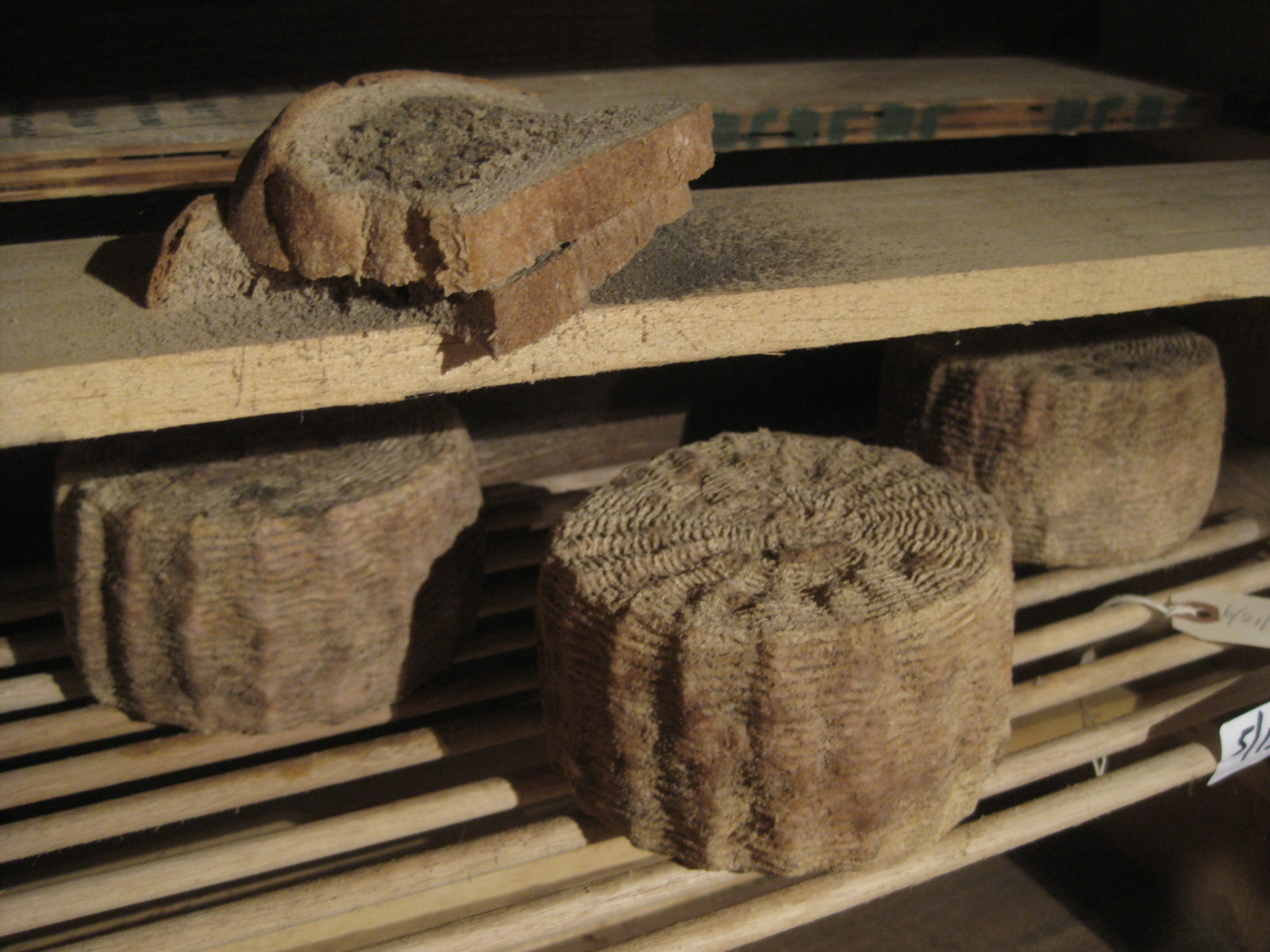
The first two picture shows some tommes, varying from a few days to six months of age. The third picture is a cabinet with mainly alpine style cheeses, also of varying age. The last pictures show some blues. These cheeses are about two months old. The bread on the shelf above the cheeses I put there to grow some mold. With this little experiment I try to grow my own blue mold which I can use to inoculate the next batch of blue cheese. The bread is rye.


Tuesday, July 20, 2010

Tiny Mushrooms


Here are some tiny mushrooms. They are growing on one of the cheeses from the previous post. They appeared after about three weeks of aging in the basement upstate. Pretty cute.


Tuesday, July 6, 2010

Rind Development


Last week I took two cheeses upstate to age them there. I wanted to see the difference between the rind development in the two different locations. My cave in Brooklyn seems to be rather sterile these days since I installed a Coolbot about a month ago.
Although the Coolbot keeps the cave at the desired temperature (56F) and the relative humidity is at 90%, I am afraid the constant air-movement created by the Coolbot has chased out all the microorganisms. At least, this is my guess. Some of the rinds on some cheeses even show little cracks. I find this very disconcerting especially as I was planning to control the climate in the planned cave at the creamery upstate in a similar way. I shall have to do some more research and consulting how to prevent this or at least come up with a better compromise.
The first four pictures are of one of the cheese I took upstate. Notice the beautiful mold development after only one week. The next two pictures are of a cheese after about three weeks in the cave in Brooklyn. No growth at all.
The last two pictures are of a cheese I made in early January. This one has been aging since then in the cave in Brooklyn. As one can see from the rind of this cheese, the cave did contain a wide variety of organisms before the Coolbot was installed.


Saturday, March 27, 2010

Cave Content


In the last post I promised an update of what's in the cave. The first picture shows some soft washed rind cheeses made on February 13 after a recipe for Vacherin. Since I took this picture I have cut into one of the cheeses. Although it is very soft, it doesn't remind me of a Vacherin as I remember them. I have washed the cheeses regularly with brine to develop a rind of the coryneform bacteria. The cheese at the right is from the same batch but I didn't wash it. I let it grow "wild".
The second picture shows some simple tommes with a washed rind. This batch was from mid January. Below it a batch of reblochon made February 22. This was a 5 gallon batch resulting in 5 two pound wheels. I washed 4 wheels regularly with a brine mixture and I let one wheel go wild as shown in the 4th photograph.
Below it two alpine style cheeses, each about 10 pound, one from early January, the other from mid February.
All cheeses mentioned above were made from Jersey milk. The cheeses in the last two pictures were made from Ayrshire milk. Some blue in the first and some lactic washed rind cheese in the last.


Sunday, January 3, 2010

Washed Rind


This cheese I made mid October from some Jersey milk. I washed the rind several times a week for about four weeks. I first used a brine for a week and after this I washed the cheeses with Marc de Borgougne for another three weeks. The white on the rind is a micrococci which appeared after I stopped the washing process.


Sunday, December 20, 2009

Tomme


I made these cheese about two months ago in the style of Reblochon. Whether they taste like a this cheese, I don't know. I had the pleasure of eating Reblochon only once, this summer in France. As far as I remember, the cheeses here did not taste like the cheese I tasted in France, but I imagine the not all Reblochon tastes the same. 
But this is not the reason for this post. These three cheese came from the same batch. I treated the rind different during aging and ended up with three rather different cheeses.
The cheese in the first two photos I washed with lightly salted water. Besides some mould in the cavities, the rind is smooth orangy yellow. The wheel in the next two pictures I washed in Marc de Borgougne. This promotes the development of  coryneform bacteria which gives it a meaty flavor. The last cheese I let go wild, I did not do anything to the rind. This rind is dry and crispy, musty and crusty.


Sunday, June 7, 2009

Goat Blue


Here are some picture of the Goat blue cheeses op close. These pictures were taken a few days ago. The cheeses are two and a half week old. I love to take these type of photographs. I find the moulds enormously fascinating.


Tuesday, May 19, 2009

Cheesecloth Stuck


Since I had not made an Alpine style cheese for a while, I had forgotten about the cheesecloth sticking to the rind. But when I started to remove the cloth from the cheese I wrote about in the previous post, I was quickly reminded of the cloth sticking to the wheel. It is hard to see, but if you look closely at the top picture, you can see the cloth being in bedded in the curd. This is a result of the enormous pressure this type of cheese needs during the pressure stage. The fact that I use a open woven cheesecloth adds to the problem. When I made some Alpine cheeses a few months ago and I experienced this problem, I vowed to get some other cheesecloth. But I guess, other priorities took a lead. 
You can see in the pictures below, pieces of curd stuck in the cheesecloth and being pulled out of the rind. The rind will end up with small craters. These are feeding grounds for molds and other rind defects. The "skin" of the cheese has been damaged. I will go on a hunt for some different cheesecloth. 


Friday, April 3, 2009

Alpine Cheese Rind


Here are some images of the rind from the Alpine cheeses. I have washed the wheels regularly to prevent mold growth. In some of the pictures you can see the impression from the cheese cloth. Even after washing and thus removing tiny layers of the surface, this impression remains. It seems as if it is layered in, or rather, the image of the cheesecloth is transfered into the cheese.