Thursday, November 13, 2008

Jersey cows milk


I have recently found a farmer upstate with Jersey cows. Should make some nice cheese, high in milk fat as seen seen below.

Wednesday, November 12, 2008

Goat de Savoie


Here are some tommes I made over the summer. The one above and just below were made on August 27 of raw cows milk. It heas a nice clean taste as well as a nice clean rind.
The cheese in the third picture was made on September 1st from raw goats milk. It has a wonderful complex goat cheese taste. Grassy, nutty and earthy, like a tomme de Savoie but made of goats milk.


Tuesday, November 11, 2008

Monday, November 10, 2008

Taleggio style washed rind cheese


A few weeks ago I made a batch of Taleggio style washed rind cheeses from 10 gallons raw cows milk. In addition to the lactic acid starter culture, I added Geotrichum candidum, corynebacteria and micrococci. After coagulation of the milk I cut the curd into one to two inch cubes. After a few minutes rest, I filled one cheesecloth lined open end form and three small soft cheese molds. The fourth picture shows the resulting cheeses.

Thinking the curd was to soft, I cut it again with a whisk into hazelnut size pieces. I let it rest again and filled the remaining forms with this. I drained the curd without pressing in the molds, some for 24 hours or more. After surface salting and some air dying, I moved them to the cave, where they are now.
The cheese right below, I secured with some wood. I was that it would sag and perhaps run off the board.


Sunday, November 9, 2008

Chaource style soft cheese


The soft cheese I made last week is ripening nicely. The picture above shows the cheeses at one week. The picture below was taken a week and a half after production and it shows the bloomy rind developing. Here and there the rind got broken while turning the cheeses a few times. They had gotten stuck to the wooden boards. Now they sit on a wooden rack and the rinds are healing. I will look into getting some soft cheese draining mats.

Saturday, November 8, 2008

Goat Tomme


a little goat Tomme after approximately three weeks

Friday, November 7, 2008

Washed Tomme


a cows milk Tomme with some mold above and washed below

Wednesday, November 5, 2008

Washed Goudas


Some washed Goudas on the lower shelf

Tuesday, November 4, 2008

Chaource style soft cheese


Last week I tried my hands at some soft ripened raw cows milk cheese. I picked up two gallons in addition to my regular ten gallon I usually get from the farmer. I added some starter culture, a pinch of Geotricum candidum and a little Penicillium candidum I warmed the milk to 24 degree Celsius (75 F). I added a few drops of rennet and let the milk sit.
After 24 hours I spooned the uncut curd into the molds and let hem drain. After another 24 hours I demolded the fragile cheeses carefully and set them on a draining mat for salting and air drying.


Monday, November 3, 2008

Gouda


Goudas with some mould


and washed

Sunday, November 2, 2008

Gouda rind


Some more Gouda rind


Saturday, November 1, 2008

Gouda rind development

In the previous post I discussed the result of the Goudas. This and some following posts contain some belated pictures of the rind development.
The picture below shows a cheese in various stages. The first two are of a one week old cheese followed by a picture of the same cheese a day later before washing. One can see the molds slowly developing on the rind.
The photographs thereafter show the cheese in various stages of development. Over time, different molds develop on the rind. For practical reasons I only washed the cheeses once a week. Hence the relatively heavy mold development.


Thursday, October 30, 2008

Gouda with holes


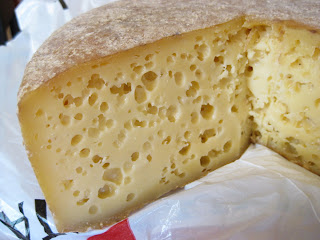
Late July/ beginning August I made my first Goudas, shown above at about two months old. Underneath is a picture of the cut cheese at three months and it shows lots of holes. Now a Gouda might have a few holes, but this many holes is not typical. The taste, as well as the odor are not typical Gouda.
I suspect, and some professional cheese makers I consulted concur, that the milk I used contained gas forming bacteria. These organisms, called Clostridium tyrobutyricum, can be in the milk when cows are fed fermented food such as silage. As far as I know, the cows I got the milk from weren't fed this, they were out on pasture. The farmer does feed them some corn during milking time and most likely some of this might have been fermented.
Before cutting the cheese, I already had a suspicion that there might be holes in the cheese. The wheel in the picture above looks swollen which is a sign of gas formation.
Although these cheeses taste nothing like Gouda, they are rather tasteful. One cheese maker mentioned Tilsit as a comparable cheese. The cheese is sharp and pungent, it reminds myself of some trappist cheeses I have had.
Wednesday, October 29, 2008

Surface mould development on Tomme

Here are some pictures of some mould development on a cows milk tomme cheese.


Sunday, October 26, 2008

Back in the Brooklyn Cheese Cave


The temperature in my cheese aging cave in Brooklyn has slowly gone down over the last few weeks. Recently it reached 55 F (12 C). Cool enough to move my cheese back in from upstate. It has become too cold and too dry there anyway.
So here they are. In the next few days, time allowing, I will post some more updates of which some are long overdue.