Monday, September 26, 2011
Moved The Vat
Finally I have moved the vat from its storage into the cheese making room. The floors are done, the walls are ready and I have doors. I also bought some large sinks on Ebay. I am very excited, the creamery starts to crystallize and it looks like I might be making cheese within the for see able future. I even submitted the paperwork with the state.
Their is still much to do however. The electricity needs to be installed, the plumbing for the water has to be put in and the various heating systems have to be installed. Their is quite a bit painting to be done and other miscellaneous touch up work. And than there is the cave. The cooling installation has arrived but I haven't had time to install it yet so that has replaced the vat in the storage. I also have to built the shelving units for the cave. I have been thinking about how to do this efficiently and cost effectively. I haven't come up with a design yet and whether to use wood, metal or a combination for the structural elements. The aging shelves however will be wood. Luckily my inspector has given me that allowance.
Monday, July 18, 2011
B173 and B175
The title of this post stands for the batch numbers of these two cheeses. In cheese making, it is important to keep good notes in case something goes wrong but also in case things turn out well.
To keep track of my batches, I number them all and imprint the number into the cheeses. In this case, the numbers are hard to see. The imprint in the cheese above is overgrown with mould and the cheese below lost a lot of the imprint from washing the cheese. Nevertheless, I can still distinguish the numbers.
So far, things have turned out very well for these two batches. The upper cheeses (B175) were made June 28 in the style of a classic tomme (though I got distracted while heating the milk so the initial ripening temperature was a little high). The lower cheese (B173) I made a week earlier combining the procedure for tallegio and reblochon. Both cheeses were made from Jersey milk and are aging in the basement of our house in upstate New York.
The microflora in this cellar is very diverse as is evidence in the cheeses from B175. The basement was built in the beginning of the last century from natural stones which there are plenty of in Delaware County. It has a concrete floor with lots of cracks and and fresh dirt on it. There are plenty of cracks and air holes in the structure so ventilation a plenty. I think it closely resemblances a natural cave. The average temperature is about 58F and might be a little high but the relative humidity of 95+% is perfect.
I did not do any rind treatment on B175, the molds are a result of the natural habitation of the basement. I intend not to do anything to the rind, I'll let it grow naturally and will observe the stages of mold development.
The cheeses of B173 I washed with a light salt brine which is traditional for reblochon. Because I am not upstate all the time, this washing schedule won't be very regular. But so far the cheeses don't seem to suffer from it. They smell fantastic.
Saturday, June 4, 2011
Creamery Construction Update
Finally, here is an update of the creamery in progress. I am nestled in approximately 1200 square feet in the left hand corner of the building above, behind the white door and the adjacent windows.
The photo below shows the outlay of the floor drains, cut into some very hard and thick concrete.
The make room and the cleaning room have a 2 feet high concrete knee wall made of three courses of concrete block. This will prevent the wicking of water from the floor and is required by NY state regulations. On top of this I have constructed a 8 feet high framed sheetrock wall. This part of the wall is covered with FRP (fiber reinforced panel) a.k.a. dairy board which makes it into a washable surface. Both of these rooms will have underfloor radiant heating. One can see the pex and concrete reinforcement laying on 2 inches of blue insulation foam board. I am about to pour the concrete for this.
The last photo shows the dry area. The walls here are bare sheetrock which will eventually be painted. At the end of this space, in the center of the picture, one can see the the entrance to the aging room. I will dedicate a post to this room in the near future.
Friday, May 27, 2011
New Cheese Cave
It has been a while since I posted. This doesn't mean I have been sitting on my laurels. I have made quite a few cheeses and ate quite a bit of it too. I have also been working on the construction of the creamery in Walton. In the next few weeks, I will add some posts about some of the batches I did and some updates on the creamery.
Apart from making cheese, I have moved my cave. I lost the cave under the Brooklyn sidewalk because the lease to the building it came with, expired. Luckily my wife and I had just bought a house in Brooklyn with plenty of space. So I have moved my cheese in there. I have converted a space under the basement stair into a cave. I have cleaned it, tiled the floor and white washed the walls and ceiling. Because the space isn't cool enough, I have installed a air conditioner run by a coolbot. This easily keeps it to the right temperature but because I did not insulate, the air conditioner is running 50 % of the time on cool mode. I might try to squirt some expansion foam into the walls or otherwise insulate the space.
To keep up the humidity, I have installed a vaporizer. I know, this kind of defeats the purpose of trying to keep the space cool as the vaporizer steams up the space. But when I have some more time on my hands, I will change this into a humidity sensor controlled mister system. As I have planned a system like this for my cave in the creamery, this would be a good opportunity to investigate its workings.
Monday, February 21, 2011
Triple Cream
Every time when I make a batch of semi-lactic cheese, the cream starts to rise to the top. By the time the curd is ready to be ladled into the moulds, there is a thick layer of cream on top. Especially this time of year when the solids in the milk are high. Lately I have been experimenting with another procedure. I let the milk acidify to a pH of 6.2-6.0 before I add a few drops of rennet. At this time I stir the milk, distributing the fat globules, which are already on top, back into the milk. By adding the rennet only at this pH level, the time it takes for the milk to coagulate should be short enough to prevent the fat particles to rise to the top.
So far, I have not mastered this procedure. Only one time I had some success. Hardly any cream was floating on top. Granted, this was when I used Ayrshire milk. The fat globules in this milk are small and less likely to rise. It is much harder to achieve with Jersey milk of which the fat globules are rather large.
In the past I used to scoop the cream from the top and used it as creme freche. Lately I have ladled it into the moulds and drained it with the rest the curds. This has resulted in some delicious triple or perhaps even quadruple cream cheeses. Yum...
Labels:
Bloomy Rind,
Chaource Style,
Lactic Type Cheese,
Triple Cream
Sunday, February 6, 2011
A big British cheese in France
A few days ago I received these two clippings about Patrick Rance in the mail. They were sent by my father-in-law, Michael, in London who has been going through his papers. My wife has been pressuring him to sort them out. Michael has never thrown away much as is evident in these two clippings. The first clipping is from the Observer, dated Sunday 3 September 1989. It is a review of Patrick Rance's "The French Cheese Book" by Jane Grigson. The second clipping, from The Independent of Wednesday 25 April 1990, is an announcement of the Glenfiddich Tropy awarded to major Rance.
I suppose the reason he kept these clippings is that his cousin Janet was married to Patrick Rance. Janet was my wife's godmother and when I got interested in cheese three years ago, my wife told me about Patrick and how he was a cheese maven. She told me about Janet and Pat and how she spent time in their home and cheese shop in Streatley. She told me how one could enter the house through the shop and see mounds of cheese, but--a teenager then--my wife was otherwise preoccupied.
When she first told me about Patrick Rance, it didn't really register. I thought he was just another cheese seller. Not until I got hold of his books, in particular "The French Cheese Book", did I realize the height of his stature. I have read this book several times and we have used it as a travel guide through France. When my wife was spending time in Streatley, she had no idea what legacy was being built in that little cheese shop, neither had she any idea what part cheese was to play in her life.
Sunday, December 5, 2010
Walton Umber
Following is a description of a cheese which I developed over the last year. I named this cheese Walton Umber after the town in upstate New York where my creamery is under construction and the earthy notes of the cheese. The cheese was described by a cheesemonger friend.
From upstate New York, Walton Umber is a cheese that is toothsome and full bodied with a long finish. Made from local raw Jersey cow milk, it is at once earthy, sweet and nutty. In a classic shape that resembles a small pecorino, the texture is firmer with buttery notes and a lightly grainy mouth feel. When eaten with the rind hints of caramel come out. Having a long tangy acidity, this cheese would pair well with fuller bodied pale ales with a good malt backbone and medium bodied red Bordeaux wines and fuller Chardonnays and would be a good complement to apples, cured meats, anti-pasti and pickles.
Tuesday, October 19, 2010
Trying Cheese
It has been a while ago since I bought my cheese trier. Since then I used it once. I have never dared to cut a core out of a cheese, afraid I would damage or contaminate it. But today I decided to give it a try. I have quite a few cheeses aging and I am curious how they are. I figure it will be a good learning curve to taste a cheese at different stages of development.
The first cheese I cored was a washed curd tomme made on July 6. The number imprinted in the rind refers to the batch number. At 3 months, this cheese was well developed and had a good body. The paste was smooth, perhaps a little granular. Being a washed curd cheese, it occurred to me that it had a typical Gouda undercurrent. I will let it age some more, I am sure it will improve with age.
The second wheel I tried was the last batch of blue I made. This was September 7, a sunny day in NYC according to my records. This cheese was made with Ayrshire milk, the breed of choice for my blue cheeses. I used my own homemade Penicillium rocqueforti, which I wrote about here. Initially I was afraid it wasn't working, it took a while for the blue to show up. But the core clearly shows blueing. At six weeks, this cheese is very mild and is definitively in need of some more aging time.
The last cheese I used the cheese trier on was an 8 months alpine style. Made on February 13 from Jersey milk, this cheese is almost ready to be cut into. The paste smells buttery, it has a sweet taste and it melts on the tongue. Being a cheese made from winter milk, the paste is a little pale.
Friday, September 10, 2010
Creamery Construction
In the last post I promised an update on the progress of the creamery I am building. Well, here are some pictures of the construction as well as plan of the creamery. As one can see by the white out, it has been through many changes and I am sure this won't be the final version yet.
So far the floors have been trenched to run the plumbing for the floor drains, sinks etc. This was a hell of job. The concrete which had to be cut was 8 inches thick and of old fashioned quality. It bore a machine shop for many decades.
Besides cutting the floor, I have been laying blocks. The make room and the cleaning room will have 2 feet high concrete knee walls. This will prevent the wicking of water behind the material on the wall. This was strongly suggested by the inspector and I don't want to start out on a arguing basis. On top of these walls I will put an 8 foot high frame wall. The large room in the back will be the aging room. The walls of this room are entirely made from concrete and insulated by 6 inch polyisocyanurate rigid foam insulation. I am not sure how to cool this room. I am deliberating various options.
Tuesday, August 31, 2010
Cave Content
I have been upstate for a month or so working among other things on the creamery. I will post an update about the creamery within the next few weeks. As I don't have easy access to internet upstate, I haven't posted much lately, my excuses for my absence.
I had taken all the cheeses with me and put them in the basement under the house. It stays relatively cool in there and the humidity is high. But above all, the micro flora is tremendous as can be seen in the previous post.
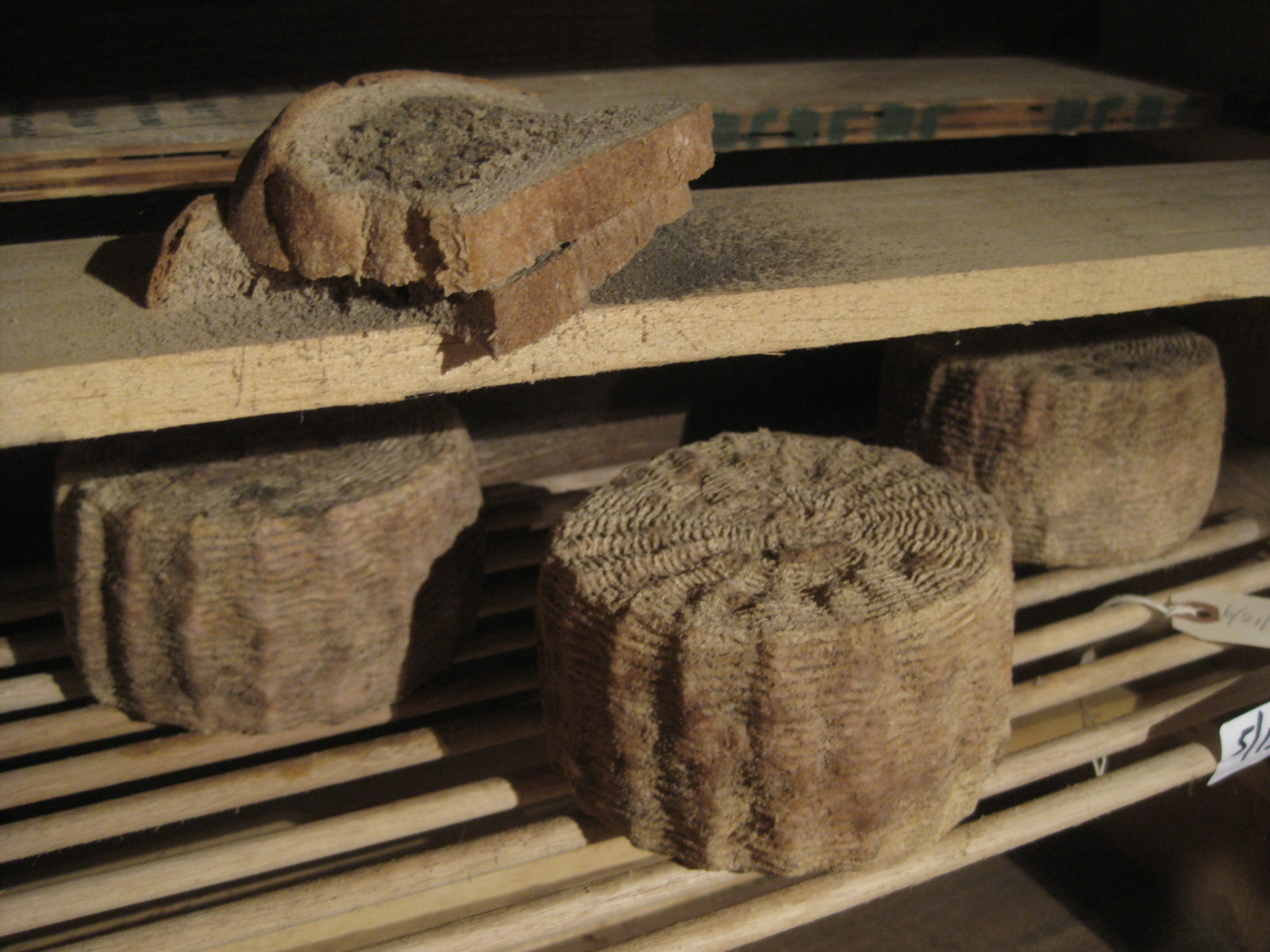
The first two picture shows some tommes, varying from a few days to six months of age. The third picture is a cabinet with mainly alpine style cheeses, also of varying age. The last pictures show some blues. These cheeses are about two months old. The bread on the shelf above the cheeses I put there to grow some mold. With this little experiment I try to grow my own blue mold which I can use to inoculate the next batch of blue cheese. The bread is rye.
Labels:
Alpine Style,
Blue Cheese,
Cheese Cave,
Rind,
Tomme,
Washed Rind
Tuesday, July 20, 2010
Tiny Mushrooms
Subscribe to:
Posts (Atom)